
tmux and Herdr become workspaces.
Sessions, agents and local shells in one native workbench.
$ curl -L -o muxterm.dmg https://github.com/wlingze/muxterm/releases/latest/download/muxterm-macos-arm64.dmg
Checking muxterm
Finished dev profile

$ muxterm list-workspaces
[1] muxterm @ local (tmux)
[2] yaklang @ remote (herdr)
[3] staging-node @ aws (ssh+tmux)
On branch main
nothing to commit, working tree clean

Runtime: tmux
Transport: local
Scene: resident
Three scenes from one window
Captured from the macOS app with mock sessions. Click a shot to open it full size.
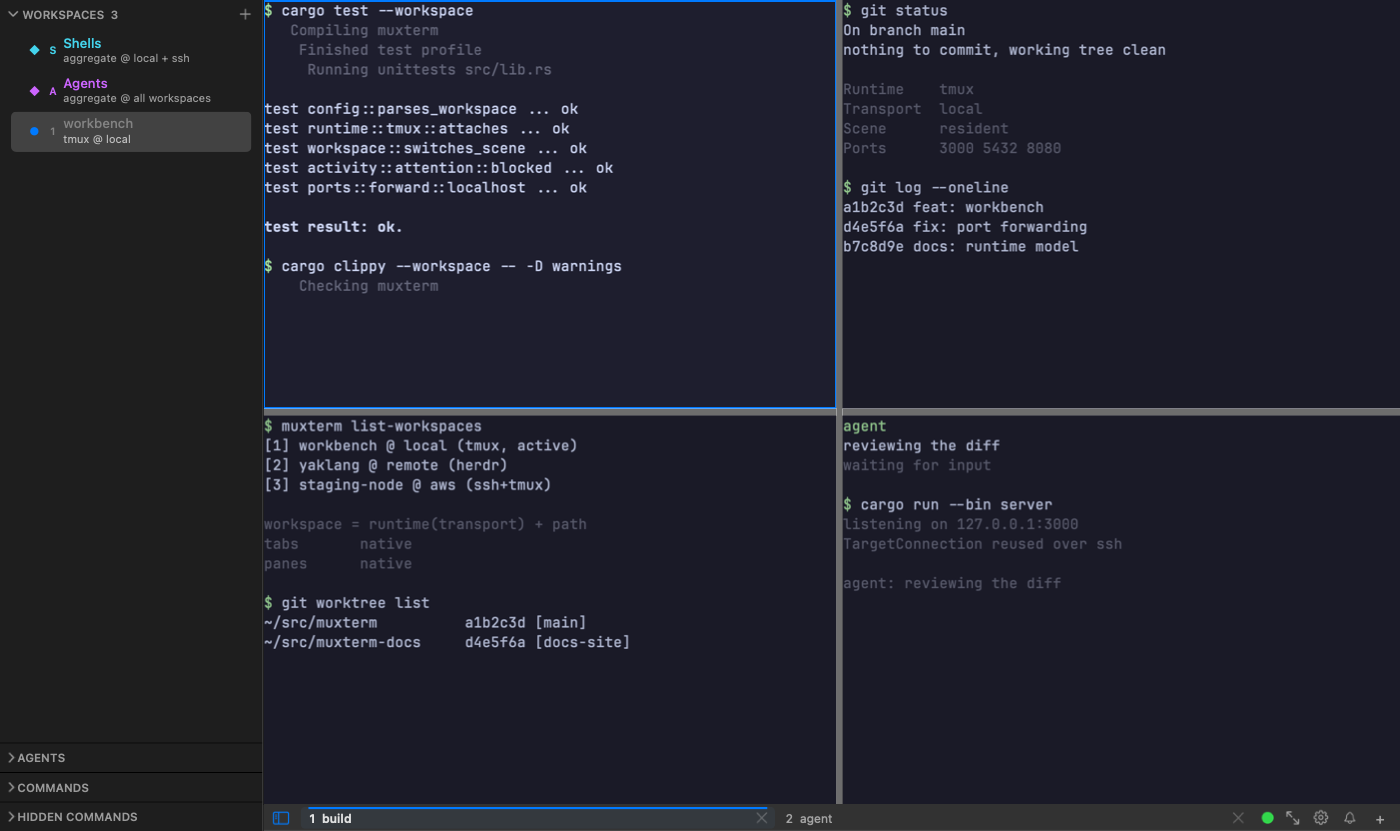
One pool for every session
A tmux session, a Herdr workspace and a project checkout share the sidebar. Each keeps native tabs and panes.
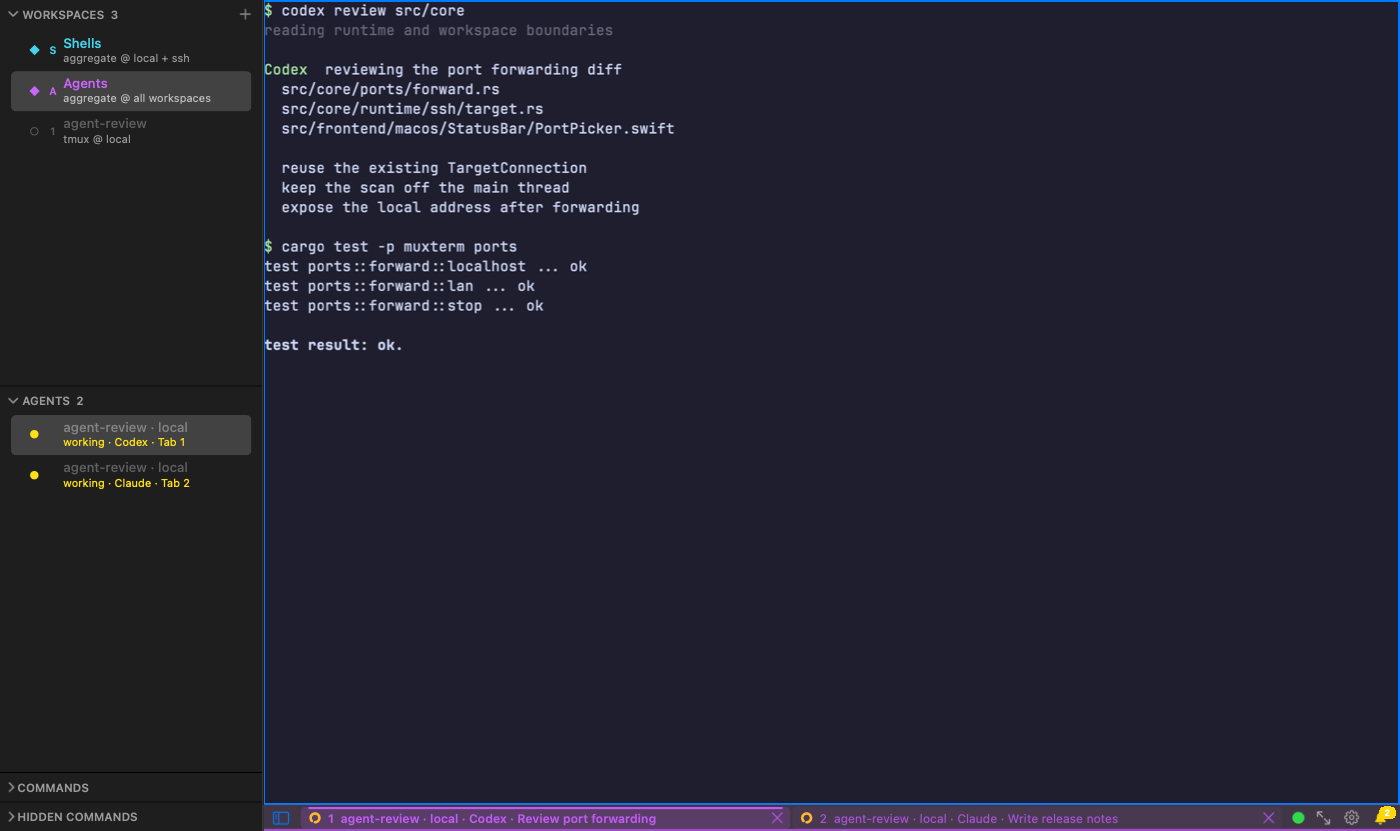
Agents report their state
Codex and Claude panes appear under Agents as working, blocked or done, so the sidebar shows who needs input.
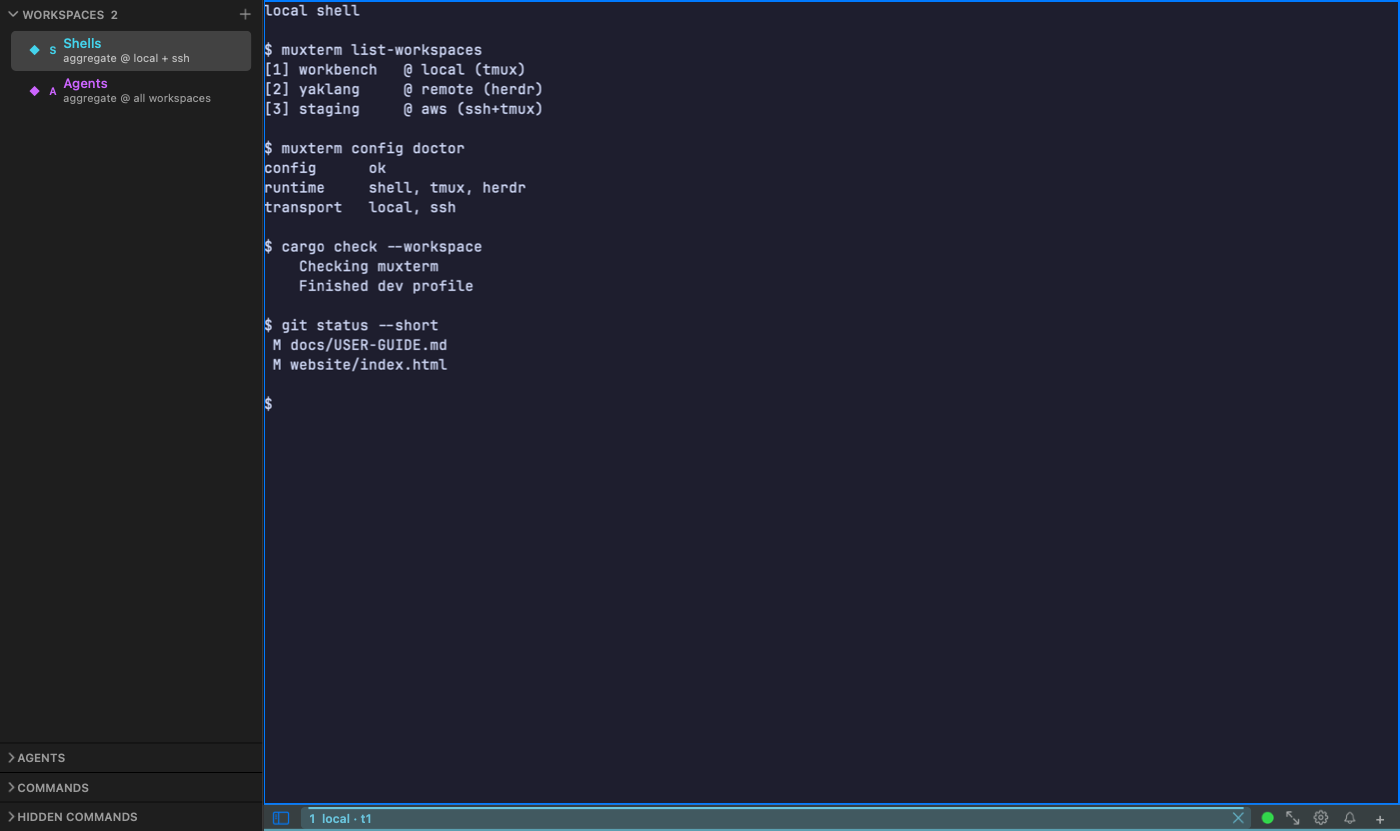
Plain shells stay plain
A local workspace needs no multiplexer. It runs a shell over the local bridge and takes input like any other pane.
Ports find you
SSH workspaces scan listening ports. Forward one to localhost, or share it on the LAN with an explicit toggle.
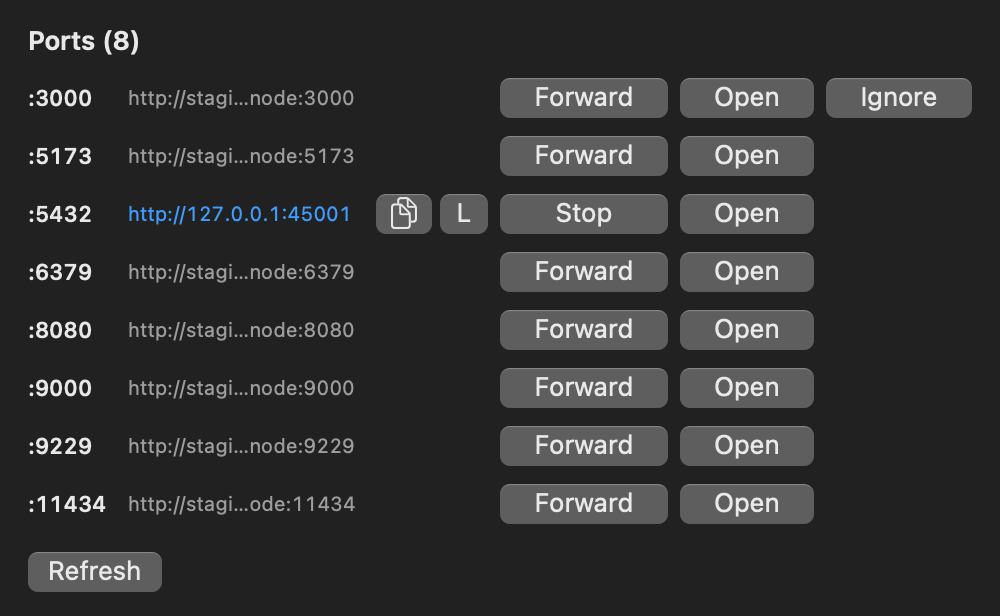
Detected ports sit behind the connection dot. Forward, open, copy the LAN address, or ignore a port for the session.
One workspace model
A workspace is a runtime over a transport plus a path. Tabs and panes are native.
| Runtime | Transport | Becomes | Keeps |
|---|---|---|---|
shell |
local / ssh | a workspace | process lifetime |
tmux |
local / ssh | a workspace per session | detach and reattach |
herdr |
local / ssh | a workspace per Herdr workspace | native worktrees |
Control lane
Native tabs and panes follow every runtime.
Render lane
Raw PTY bytes go straight to native surfaces.
Activity lane
Agent state stays in the workspace that owns it.
Download
Desktop bundles, a terminal UI, or a source build.
macOS ARM64
Apple Silicon, macOS 13+.
Linux x86_64 GTK4
GTK4 bundle with vte4.
Terminal UI
Runs in any terminal.
From source
Rust 1.97.1 or newer.